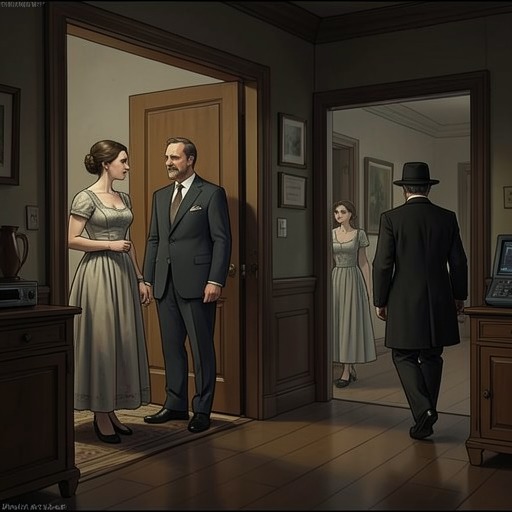
Schwindgasse 15·2 Apartment
The World According to GarpSchwindgasse 15/2 Apartment is Jenny Fields and T. S. Garp’s home in Vienna, a second-floor residence where their different ways of inhabiting the city take shape. Jenny stays close to the neighborhood and concentrates on writing about her past; Garp ranges through museums, streets, and historical sites, then returns to share what he has found. The apartment is both the base for this daily contrast and a place where Vienna’s visible traces of war feed Garp’s reflections on family, death, and the work of memory.
Setting and Neighborhood
The apartment occupies the second floor of an old building on Schwindgasse, a little street in Vienna’s fourth district. Its cream-colored walls and high ceilings give it an established, spacious character. The location places the pair near Prinz-Eugen-Strasse, Schwarzenbergplatz, and both the Upper and Lower Belvedere; the Bulgarian Embassy stands directly across the street. Karlskirche and embassy buildings on Argentinierstrasse are also within walking distance.
The surrounding landmarks offer Garp a city to investigate on foot and by streetcar. Jenny, however, prefers the familiar bounds of the neighborhood. She sometimes visits a nearby coffeehouse to read English-language newspapers, and she will walk to the Upper Belvedere, but she declines Garp’s suggestions to take the streetcar to the Kunsthistorisches Museum or continue through the Belvedere gardens to the Lower Belvedere. Her choice is not presented as simple lack of access: she says that her art-history courses at Steering have given her enough education, and that the nineteenth and twentieth centuries are enough for her. In the contrast between her limited itinerary and Garp’s expanding one, the apartment becomes a home base for two distinct approaches to Vienna.
Jenny’s Routine and Writing
At forty-one, Jenny regards the most interesting part of her life as already behind her and wants to write about it. She tells Garp that she has no time to be a tourist and urges him to absorb the city’s culture, while she stays focused on the story she has to tell. At this point she is more absorbed in the prospect of writing than he is. Her preference for remaining in the neighborhood thus accompanies a change in her attention: Vienna is not primarily material for sightseeing, but the place where she can put her own life into words.
Her daily habits give the apartment a distinctive domestic rhythm. Jenny does not go out to eat unless Garp takes her, and she does not eat at home unless he cooks. She is equally untroubled by whether dinner is eaten in or out. In the late afternoon, when she has finished writing, Garp may take her out for beer or wine and describe his day; she listens politely, though the drinks make her sleepy. They usually have dinner somewhere and return by streetcar, with Garp taking pride in his command of the routes and in never using taxis. On other days he visits the open markets in the morning, comes home early, and cooks through the afternoon. The routine makes his explorations and practical care for Jenny part of the same pattern: he goes out to gather experience, then brings the city back to their shared evenings.
Address, Care, and Independence
Garp gives Jenny a paper bearing their address, Schwindgasse 15/2, Wien IV, in case she gets lost. He also has to teach her how to pronounce it, a lesson that becomes a small domestic contest. Jenny spits out the long compound street name, and Garp prompts her to try again, asking whether she wants to remain lost once she gets lost. The exchange turns an address into a practical marker of their life together: Jenny has chosen a small radius, but Garp makes sure she can find her way back to it.
The episode also shows that their different habits do not amount to a simple conflict. Garp encourages Jenny to see more of Vienna and offers explanations about its museums, but he does not insist that she adopt his itinerary. Instead, he escorts her, finds places to take her, and cooks when they stay in. Jenny listens to his accounts without sharing his appetite for exploration. The apartment accommodates both the son’s outward movement and the mother’s inward concentration, without making either one the measure of the other.
War, Memory, and the Writer’s Work
Garp’s exploration extends beyond art museums to the zoo on the grounds around Schönbrunn Palace. Many of its buildings appear to him to be war ruins, three-quarters destroyed and only partly restored for the animals. That uneven restoration gives him the eerie impression that the zoo still belongs to Vienna’s wartime past. He becomes interested in that history and, at night, reads specific accounts of the city under Nazi and Russian occupation. The damaged zoo and the historical reading deepen the death themes that haunt his work on “The Pension Grillparzer.”
The apartment itself also holds a material trace of violence: Garp feels the holes left by machine-gun fire in the stone walls of its lobby. The damage links the home to the city’s history, rather than setting domestic life apart from it. As Garp understands it, a city’s history resembles a family’s: closeness and affection persist, but death eventually separates people from one another. The surviving marks of war make that thought more than an abstraction; past violence remains legible in the building where he and Jenny live.
From this conjunction of home, ruined buildings, and historical accounts, Garp arrives at a principle of writing. Everything seems related to everything else when a writer is working: Vienna’s damaged spaces lead him toward the history of a family, and both lead back to death and memory. He concludes that vivid memory keeps the dead alive, while a writer’s task is to imagine experience with enough personal intensity for fiction to become as vivid as memory. Schwindgasse 15/2 Apartment therefore functions not only as Jenny’s refuge for writing her life, but as the setting from which Garp learns to connect a place’s visible past with the intimate losses that shape a family.